Sunday, March 25, 2012

The Fateful and Chaotic Epic known as the meeting of Anton and Fake


One of the books primary themes, Fate, just happens to construct this random and unexpected meeting between Anton and Fake Ploeg Jr. This happens in the 3rd episode of the book, second chapter and in the year 1956. This was a pretty important chapter that happens to bring up Anton’s past and it helps the readers have a better understanding of the two very different characters of Anton and Fake.

There is quite the play on contrast between Anton and Fake and their two personalities. Their statuses and lives have changed since what happened years before and throughout their meeting the difference is quite evident. As Fake comes into Anton’s apartment he places his stone down upon Anton’s grand piano. This causes Anton to cringe as the stone scratches the lacquer of the piano, emphasizing that Fake doesn’t know how to deal with such luxury in life and already shows the reader the gap between the two.

Another part of this meeting that shows the difference between their statuses is when Anton offers his guest a drink. Fake chooses to have beer whereas Anton himself has wine. Beer is for the workers class of society whereas wine is for those of higher education.

Thursday, March 1, 2012

Information and Sourcing *giggles*


3 kinds of information
common knowledge
specific information: detail, examples, new evidence
                    footnote or source in text
Direct quote? or paraphrase (is it succinct? if yes, quote. if no, paraphrase)
=> no more than two lines                 source it

Sunday, February 12, 2012

Great Gatsby Film VS Book


The Great Gatsby by F. Scott Fitzgerald is said to be ‘the supreme American novel’, but is it possible to say the same for the film adaptation of this classic piece of literature? The television film adaptation of The Great Gatsby done in the year 2000 was by the A&E Cable Network. The film and the book were vastly similar but there were also the few details that stuck out and differentiated it from the actual book. The book portrays the motif of car crashes, literally and metaphorically, quite differently than the film version.

                  The actual car crash that had the biggest effect on the viewer/reader in both the book and the film is when Daisy accidently hits Myrtle Wilson, a hit and run. When reading this in the book one can’t really picture the scale of the impact or the way in which Myrtle was hit. In the book, Tom, Jordan and Nick are driving back from New York and they see the commotion and the whole scene. There wasn’t any part in the book where the author wrote the actual happening of Daisy hitting Myrtle. The film was able to provide a graphic and intense display of Myrtle getting run over, something the book was lacking. This had a more serious effect on the viewer of the film as well. Car crashes in a metaphorical sense are different but just as shocking.

                  Once such metaphorical car crash is that sudden and surprising moment when Tom smacks Myrtle across the face and causes her nose to bleed. Like the previous car crash stated, this one was also dulled over in the book, it was a quick and less serious situation in the book. It was over in a matter of seconds as well. In the movie, there was the whole scene played out and the viewer is able to visually experience the aggressiveness of Tom and the silliness of Myrtle. The use of sound is also very important in this metaphorical car crash, the slap across Myrtle’s face can be heard and with this it becomes more severe.

                  There was the first car crash in the book, the one dealing with Owl Eyes after he had left Gatsby’s party. This whole scene took up quite a few pages in chapter three, although within the film this scene did not take place. The director had probably decided to leave the scene out, seeing as how it could be sacrificed to fit more important scenes in the movie. Owl Eyes is seen once in the film and that’s it for him, a very minor character in both film and book.

                  Basic definition of a crash is for an object to collide violently an obstacle or another moving object. The car crashes, metaphorically and literally, within The Great Gatsby are all quite drastic and unexpected. The car crash is an effect that is well played out in both the film and the book; it provides various climaxes throughout the story. It shows the extent to which things can suddenly turn bad and mess up in common day happenings.

Wednesday, February 1, 2012

Rich are Different, Gatsby, Car Crashes

They’re a rotten crowd: all the characters in The Great Gatsby. This book, written by F. Scott Fitzgerald, is composed of and influenced greatly by three important factors. The first of these is the theme ‘Rich are Different’. When reading the book and thinking of this theme, there are many ways it could be connected to various aspects of the book and it’s characters. The second factor would be the most important character within the story and his name is Jay Gatsby. Who is he at first? He’s a mysterious figure throughout the story with only one thing on his mind. The last factor would be this recurring symbol of car crashes. There are only a few actual car crashes within the story but there’s also car crashes within a metaphorical sense. It all started off with Gatsby really.

‘To the young Gatz, resting on his oars and looking up at the railed deck, the yacht represented all the beauty and glamour in the world’ (Page __). This is a scene in the book referencing to Gatsby’s past and the beginning of his new life. The way it expresses the theme Rich are Different is how he sees Dan Cody’s yacht in front of him. Gatsby in the past has never experienced riches and has had a few odd jobs before meeting Dan Cody. This was his first time seeing such wealth and to him it was beautiful and perfect. The difference between the yacht and Gatsby’s own tiny boat emphasizes the theme being expressed. Gatsby completely ditches his previous lifestyle to take part of this golden opportunity with Dan Cody to go sailing on his yacht. In a way this expresses Gatsby and the question posed by his character: ‘Who am I?’ Nobody knew about Gatsby’s past except for Nick and not really anybody would expect Gatsby to have been so poor when young. This is a ‘car crash’ in Gatsby’s life as he has the best chance to experience how the wealthy live. Its sudden and unexpected, a very rare chance.

 'Your wife doesn’t love you,’ said Gatsby. ‘She’s never loved you. She loves me.’ (Page ___) Nick tries to get everybody up and leave, saying how nobody wants a drink. This is the moment Gatsby says to Tom that Daisy has never loved Tom but that she instead loves Gatsby. The Rich are Different theme is shown when they’re having this little afternoon party in the city. These rich people can go out and do whatever whenever they feel like it. Somehow they have time to do all these things. Gatsby thinks and hopes that all of sudden by confessing that Daisy loves him that she’ll leave Tom. This might have happened but Tom and Daisy have already spent years together, even bring up a child. Gatsby doesn’t realize this and acts as if he can do whatever he want, ignoring common rules of society. The car crash in this article would be the sudden and outrageous confession made by Gatsby to Tom. Gatsby tries to win through this but Tom is unbreakable.

‘Daisy! Daisy! Daisy!’ shouted Mrs. Wilson. ‘I’ll say it whenever I want to! Daisy! Dai——‘ Making a short deft movement Tom Buchanan broke her nose with his open hand. (Page ____) This is at a party where Daisy gets a little too drunk and pushes Tom over the edge by mentioning Daisy’s name when he told her not to. The theme of Rich are Different is evident here, Mrs. Wilson has been experiencing the luxury that Tom provides and is literally drunk off of it. The rich are basking in their money and alcohol at these parties and it is evident how amateurs like Myrtle can be swept away by the parade. Gatsby and Daisy are connected in a way, when you think of Daisy you also think of Gatsby. Like a real car crash, this is sudden, powerful, and shocking. Tom loses his temper and suddenly slaps Myrtle; it’s unexpected and just shows how overbearing he is
 
“ ‘I thought so; I told Daisy I thought so. It’s better that the shock should all come at once. She stood it pretty well.’ He spoke as if Daisy’s reaction was the only thing that mattered. ” (Page ___) This was the moment where Daisy accidently ran over Myrtle Wilson also killing her in the process. The theme Rich are Different is occurring here because Gatsby and Daisy drive off after hitting Myrtle, too scared and shocked to do anything about or they just didn’t want to deal with the issue of getting arrested. Most people no matter what would stop and assess the situation, damage, and see if the victim was alive or not. Too worried about themselves; Daisy and Gatsby ignored these common sense rules and ran away from the scene. Gatsby and his character’s personality ‘Who am I? Is within this quote when the great Gatsby himself chooses to quickly breeze over the fact that he and Daisy killed somebody although he does plan to take the blame to save Daisy. The motif of car crashes in this quote is actually a real car accident; this event is sudden and gruesome.

 ‘The chauffeur—he was one of Wolfshiem’s protégés—heard the shots—afterward he could only say that he hadn’t thought anything much about them.’ (Page __) This is right when revenge-filled Wilson had come over and shot Gatsby while he was relaxing in his pool. Rich are different plays in this quote when it shows the relaxed mind-state that Gatsby has even after something as tragic as Myrtle’s death happened. He’s chilling in his pool without too many cares and the exact opposite of his being is Wilson. Wilson is a complete wreck compared to Gatsby, he just lost the woman he loves and yet she doesn’t love him back. Gatsby and his ‘Who am I?’ character are portrayed by the fact that Gatsby isn’t even the one who run over Myrtle, instead it was Daisy who did it. The car crash within this quote is that Gatsby was shot suddenly and unexpectedly.

 Gatsby was worth the whole damn bunch put together. Throughout The Great Gatsby there is constant connections to the theme Rich are Different. It's an important and powerful theme within the book and it affects all the characters. Gatsby himself is greatly affected by the theme and even the constant question of his personality and character 'Who am I?'. The motif of car crashes brings everybody back to reality with their sudden and tragic ends. These three key things compose the story and dictate it.

Tuesday, December 13, 2011

Chapters 3 and 4 Qu0tes

Chapter 3

1. "In the main hall a bar with a real brass rail was set up, and stocked with gins and liquors and with cordials so long forgotten that most of his female guests were too young to know one from another." Pages 41-42. One of the main motifs of the book; alcohol, is constantly present at these parties.

2. "They were, at least, agonizingly aware of the easy money in the vicinity and convinced that it was theirs for a few words in the right key." Page 43. Nick is narrating in his judgmental way about how these Englishman at the party were trying to sell bonds or insurance or automobiles. Stating at how the rich Americans at the party were 'easy money'.

3. "... representing the staid nobility of the country- side—East Egg condescending to West Egg, and carefully on guard against its spectroscopic gayety." Page 46. Here Nick makes a referral to East vs. West, how East egg seems to be more

4. "The two girls and Jordan leaned together confidentially. ‘Somebody told me they thought he killed a man once.’" Page 45. Here's the start of some gossip between Nick, Jordan, and a few others concerning Gatsby's past. Gatsby's past is unknown to his multitude of guests and seems to be quite the topic.

5."It understood you just so far as you wanted to be understood, believed in you as you would like to believe in yourself..." Page 49. In this text, Nick is thinking of Gatsby's smile and determining how it felt when looking at his smile, he was completely mesmerized by it for a second.

Chapter 4

1. ‘Good morning, old sport. You’re having lunch with me today and I thought we’d ride up together.’ Page 62.

Thursday, November 24, 2011

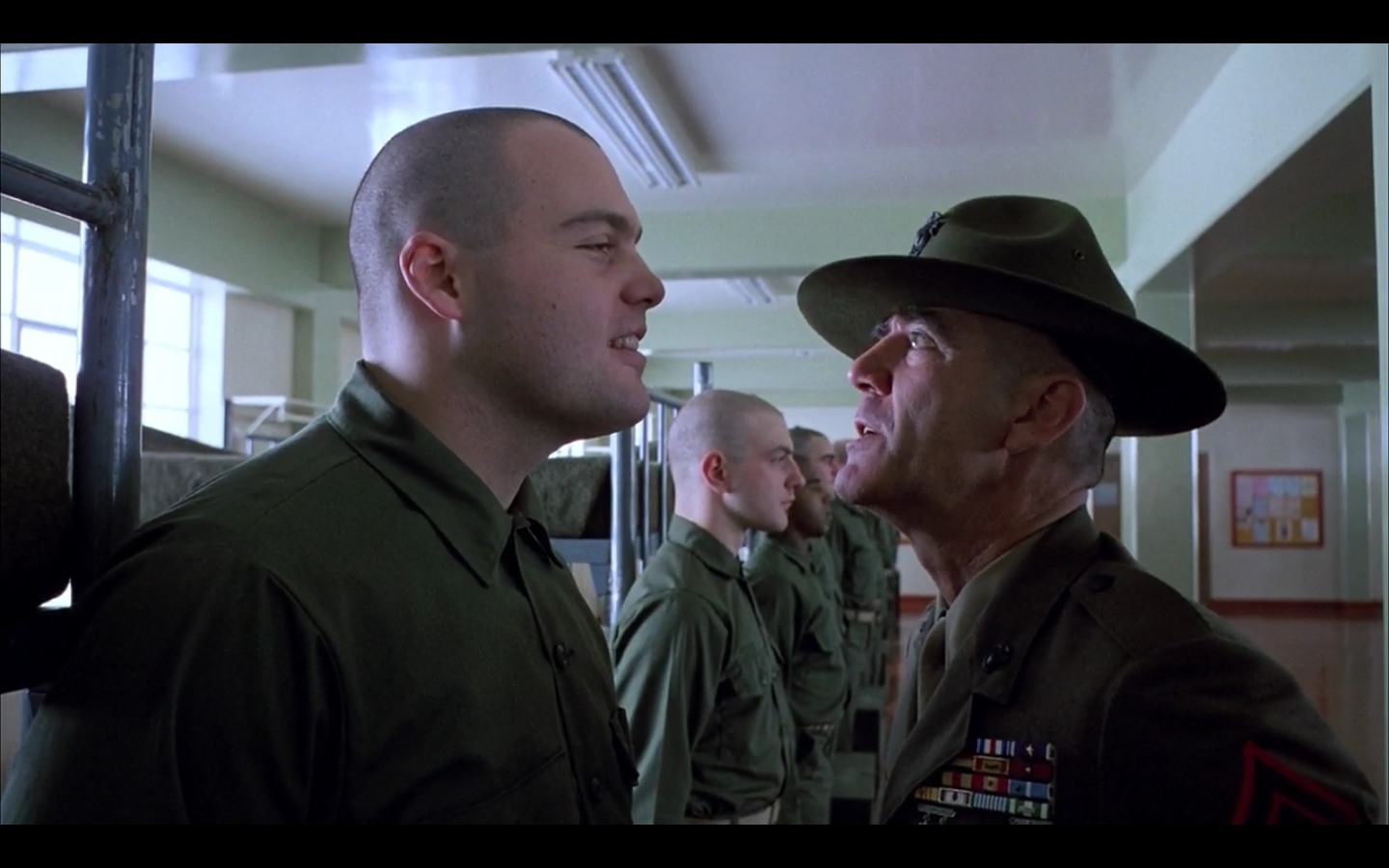
Shots

Following the man as he walks along the line of privates. Somewhat low angle with a medium shot.
 Close-up on the two characters at an eye level angle sorta.
 Long shot with a view of everybody, camera follows the man until he reaches the far left. Eye level angle.
 Low angle and a medium close up

 
 Big close-up of the man's face.
Big close-up and a somewhat over shoulder shot
Another big closeup with an over shoulder view. Eye level angle


Wednesday, November 23, 2011

Ma Veray Furst Memoray

The text being analyzed is the poem First Memory by Louise Glück, a poem possibly about some of the memories the author had as a child.

The first big idea would have to be revenge, that's what drives the thought in this poem. The word wounded could be in service of this idea of revenge. He's been 'wounded' and wants revenge for the wrong-doing. At the end of this idea there is repetition of a certain phrase: 'For what he was - for what I was:'. Although the 'he' and the 'I' are in juxtaposition to each other. The colon forms the transition to the next big idea.

The two most important words of this second big idea are most likely pain and loved. The pain was connected to the fact that he wasn't loved, or rather that's what he thought the pain was. The word loved is repeated, although with contrasting context 'I was not loved. It meant I loved.' The author starts the first idea and second idea the same by saying 'Long ago' and 'From the beginning of time'. Both of these statements are a reference to his past.

This poem portrays a memory and strong emotion through the author's use of repetition and punctuation.