Sunday, June 3, 2012

June 4

Story 1: Toure Party
-Football matches
-Scores
-Highlights
-> Yaya double fires
->City closer to title

Story 2: TOWIE Mark's forgettable in bed
-Sexy chica photo with a guy in the corner
Story 3: Tent girl 14, killed by BBQ

Story 4: Sherlock sexier than 1D

Story 5: Bunch of Jessies
-Celebrities
-Voice ratings trounced by BGT
-Beeb tells coaches: Toughen up

The Sun is for the lower class and uneducated due to the stories told

Tuesday, May 8, 2012

Logical Fallacies: Fallacies of Relevance

Personal attacks (arguments 'ad hominem' - is ambiguous) attempt to discredit a point of view by discrediting the person that holds it. The character of the person that holds a view, though, entails nothing about the truth of that view. Such arguments therefore commit a fallacy of relevance.
Appeals to consequences attempt to persuade someone to accept a position based either on the good consequences of their accepting it or on the bad consequences of their not accepting it. There is no guarantee, though, that the position that has the best consequences is true. Again, then, such arguments commit a fallacy of relevance.

 Examples:
Arguing via threat: "I deserve a good grade, wouldn't you agree? If you don't agree, I'm afraid about what might happen: I just can't control Bruno here".

Attempting to convince by appealing to the natural desire we all have to be included, or liked, or recognized. This type of fallacy breaks down into several sub-types.
Bandwagon: Of course God exists. Every real American believes that. Other related types: Appeal to Vanity; Appeal to Snobbery ("Of course you should cheat; all the cool people are doing it").
Appeal to Common Practice. Example: "Hey, everyone speeds. So speeding isn't wrong".
From Hypocrisy: You've claimed that smoking is bad for one's health; but you smoke too. 

Sunday, May 6, 2012

Essaysyaya


Question: Some characters in fiction are somehow familiar and naturally believable; others are unlike anyone we have ever encountered. How have at least two writers in your study made exotic or even previously unimaginable characters both interesting and credible?

Building upon the depth of key or noticeable characters within various forms of literature is difficult but overall piques the interest and curiosity in readers. There are many characteristics and personality types from which a writer can base their characters upon and thus expand on. In a way the character could have this preset personality of ‘short tempered’ or ‘outgoing’, from these writers could morph or even deform the character into something genuine and imaginative. The White Tiger by Aravind Adiga is a book that centers on the intriguing self-proclaimed social entrepreneur Balram Halwai; a character that with all certainty is like no other. Balram’s life and personality contrast greatly from yet another unique character, Anton Steenwijk of Henry Mulisch’s The Assault who is constantly running from the past.

‘In any jungle, what is the rarest of animals – the creature that comes along only once in a generation? The white tiger. That’s what you are in this jungle.’ (p. 35) This quote emphasizes how different Balram was, even at a young age, from all the other children in his class. The jungle that is referred to is the masses of unintelligent kids who not like Balram. The inspector questioning him on various things acknowledges Balram as being one of a kind and as someone with potential. This is what could be said as the start of Balram’s uniquity, he’s offered a real education but such hopes are quickly shot down in the Darkness.

‘The Rooster Coop was doing its work. Servants have to keep other servants from becoming innovators, experimenters, or entrepreneurs … The coop is guarded from the inside.’ (p. 193) The coop symbolizes India as a country; the chickens in the coop are the people themselves. The masses of India, including Balram at a time, just kept pulling each other down further into the coop. Not one of them could become anything more than just a servant; they all unwittingly obstruct each other’s desire or motivation to do more in life. The one thing that ties down people from carrying on is as Balram says; ‘… the Indian Family.’ The majority of money Balram makes is sent back to his family to help them, it’s seen as a must do in Indian society. Family comes first within the mindset of the people. There is one such rarity that alters their mindset though, one such exception that flew the coop.

‘Can a man break out of the coop? … That would take no normal human being, but a freak, a pervert of nature. It would, in fact, take a White Tiger. You are listening to the story of a social entrepreneur, sir.’ (p. 177) Balram the White Tiger, the social entrepreneur, is that freak and pervert. He himself states how it’s possible to break out. Saying how ‘… only a man who is prepared to see his family destroyed … can break out of the coop.’ (p. 176) The moment Balram kills his master, he stops being a slave and sees how beautiful the world is, thus escaping the coop.

Balram is a social entrepreneur. He’s the White Tiger. He’s either the only or one of the far few who has escaped the rooster coop. Balram has been through a lot in The White Tiger and through his experiences readers gain a sense of how intricate and perplex his character and his mindset are. The main character of The Assault, Anton, starts off as a 12-year-old boy whose innocent family is brutally executed. He goes through life constantly avoiding situations regarding his past, forcing him to forget by trying to live normally.

'... a gray mountain rose up, a tidal wave that broke all around him ... The rock broke through the plaster and through his brain.' (p. 155) Anton's memories throughout the book are symbolized by stone. This giant gray mountain that assembles and towers before him during his attack are all of his built up memories that he's been trying to hard to keep hidden and submerged. It suddenly attacks him all in this single moment.

‘… But he knew if he once began taking tranquilizers he would never stop.’ (p. 156) A doctor had given Anton a prescription for Valium if he were to ever go through another hallucinatory anxiety attack. He quickly tore it up believing that if he started resorting to drugs to dull the pain then he would always be stuck with it. Maybe a small part of Anton’s conscious desired him to know more about his past and therefore making him stay away from tranquilizers.

‘He had no desire to know.’ (p. 57) This short and simple sentence sums up the rest of Anton’s life, constantly avoiding the pain from the past, to the point of even becoming an anesthesiologist. Anesthesia is a drug injected into patients before surgical operations to desensitize the patient from all pain. Anton could have become a doctor but he thinks that doctors are pure butchers; cutting up people and causing pain. 

Within these two books The White Tiger by Aravind Adiga and The Assault by Harry Mulisch, there are two complex and powerful characters Balram and Anton. They live in two different time periods and have been exposed to completely contrasting stories but the writers have still portrayed to them well.

Sunday, March 25, 2012

Reflection 108 to 116


As with Anton’s sudden and unexpected meeting with Fake Ploeg Jr. ten years later he has this fateful meeting with the man who changed his whole life in the fourth episode of the book. This man is Cor Takes, who happened to be the man who shot Fake Ploeg Sr near Anton’s house in Haarlem. The theme Fate again plays an important role throughout these pages seeing as how by chance Anton overhears Takes say ‘I shot him first in the back, then in the shoulder, and then in the stomach as I bicycled past him.’

As soon as Takes learns of who Anton is and what else he knows, his face suddenly goes pale, ‘As if the light had changed, he now turned as pale…’ This happens as the truth of the situation suddenly dawns on Takes and he becomes nervous or scared in a way. The motif of Light is important throughout this book and especially within this meeting, as light represents understanding.

As Takes and Anton proceed to leave the cluster of people, they step outside and the weather is sunny. This links to the motif of light and could possibly express the light’s understanding. Another part of Anton’s mystery filled past is about to be revealed to him.

Anton always chooses to run away from anything dealing with his past, going so far as to try to convince Takes to completely forget Anton even said anything and to just continue on with their lives. ‘Let’s get up and walk out of here and never mention it again.’ Anton tries to state that what happened twenty years ago doesn’t even bother him and he wants to take back what he said earlier. Takes is adamant though and dispels Anton’s reasoning by stating the facts and all that just happened.

Anton appears to be somewhat scared of Takes, which is why he was shivering. His thoughts on Takes is ‘… a nameless violence such as he had never known in anyone…’ He was hesitant about saying such so he decided not to. Anton's observations of Takes throughout this chance meeting helps develop Takes as a character.

The motif of Stone is also pretty dominant within this scene of the book. They're at a funeral, in a cemetery and there's various mentions of gravestones. Stones within the book represent memories and what those memories meant to various characters. As a cloud passed over the sun, the shadow covered the gravestones, the new one became slightly bleached and the old ones were more of a dominant darker gray. The cloud passed quickly though and the sun lit up the area once more.

The Fateful and Chaotic Epic known as the meeting of Anton and Fake


One of the books primary themes, Fate, just happens to construct this random and unexpected meeting between Anton and Fake Ploeg Jr. This happens in the 3rd episode of the book, second chapter and in the year 1956. This was a pretty important chapter that happens to bring up Anton’s past and it helps the readers have a better understanding of the two very different characters of Anton and Fake.

There is quite the play on contrast between Anton and Fake and their two personalities. Their statuses and lives have changed since what happened years before and throughout their meeting the difference is quite evident. As Fake comes into Anton’s apartment he places his stone down upon Anton’s grand piano. This causes Anton to cringe as the stone scratches the lacquer of the piano, emphasizing that Fake doesn’t know how to deal with such luxury in life and already shows the reader the gap between the two.

Another part of this meeting that shows the difference between their statuses is when Anton offers his guest a drink. Fake chooses to have beer whereas Anton himself has wine. Beer is for the workers class of society whereas wine is for those of higher education.

Thursday, March 1, 2012

Information and Sourcing *giggles*


3 kinds of information
common knowledge
specific information: detail, examples, new evidence
                    footnote or source in text
Direct quote? or paraphrase (is it succinct? if yes, quote. if no, paraphrase)
=> no more than two lines                 source it

Sunday, February 12, 2012

Great Gatsby Film VS Book


The Great Gatsby by F. Scott Fitzgerald is said to be ‘the supreme American novel’, but is it possible to say the same for the film adaptation of this classic piece of literature? The television film adaptation of The Great Gatsby done in the year 2000 was by the A&E Cable Network. The film and the book were vastly similar but there were also the few details that stuck out and differentiated it from the actual book. The book portrays the motif of car crashes, literally and metaphorically, quite differently than the film version.

                  The actual car crash that had the biggest effect on the viewer/reader in both the book and the film is when Daisy accidently hits Myrtle Wilson, a hit and run. When reading this in the book one can’t really picture the scale of the impact or the way in which Myrtle was hit. In the book, Tom, Jordan and Nick are driving back from New York and they see the commotion and the whole scene. There wasn’t any part in the book where the author wrote the actual happening of Daisy hitting Myrtle. The film was able to provide a graphic and intense display of Myrtle getting run over, something the book was lacking. This had a more serious effect on the viewer of the film as well. Car crashes in a metaphorical sense are different but just as shocking.

                  Once such metaphorical car crash is that sudden and surprising moment when Tom smacks Myrtle across the face and causes her nose to bleed. Like the previous car crash stated, this one was also dulled over in the book, it was a quick and less serious situation in the book. It was over in a matter of seconds as well. In the movie, there was the whole scene played out and the viewer is able to visually experience the aggressiveness of Tom and the silliness of Myrtle. The use of sound is also very important in this metaphorical car crash, the slap across Myrtle’s face can be heard and with this it becomes more severe.

                  There was the first car crash in the book, the one dealing with Owl Eyes after he had left Gatsby’s party. This whole scene took up quite a few pages in chapter three, although within the film this scene did not take place. The director had probably decided to leave the scene out, seeing as how it could be sacrificed to fit more important scenes in the movie. Owl Eyes is seen once in the film and that’s it for him, a very minor character in both film and book.

                  Basic definition of a crash is for an object to collide violently an obstacle or another moving object. The car crashes, metaphorically and literally, within The Great Gatsby are all quite drastic and unexpected. The car crash is an effect that is well played out in both the film and the book; it provides various climaxes throughout the story. It shows the extent to which things can suddenly turn bad and mess up in common day happenings.

Wednesday, February 1, 2012

Rich are Different, Gatsby, Car Crashes

They’re a rotten crowd: all the characters in The Great Gatsby. This book, written by F. Scott Fitzgerald, is composed of and influenced greatly by three important factors. The first of these is the theme ‘Rich are Different’. When reading the book and thinking of this theme, there are many ways it could be connected to various aspects of the book and it’s characters. The second factor would be the most important character within the story and his name is Jay Gatsby. Who is he at first? He’s a mysterious figure throughout the story with only one thing on his mind. The last factor would be this recurring symbol of car crashes. There are only a few actual car crashes within the story but there’s also car crashes within a metaphorical sense. It all started off with Gatsby really.

‘To the young Gatz, resting on his oars and looking up at the railed deck, the yacht represented all the beauty and glamour in the world’ (Page __). This is a scene in the book referencing to Gatsby’s past and the beginning of his new life. The way it expresses the theme Rich are Different is how he sees Dan Cody’s yacht in front of him. Gatsby in the past has never experienced riches and has had a few odd jobs before meeting Dan Cody. This was his first time seeing such wealth and to him it was beautiful and perfect. The difference between the yacht and Gatsby’s own tiny boat emphasizes the theme being expressed. Gatsby completely ditches his previous lifestyle to take part of this golden opportunity with Dan Cody to go sailing on his yacht. In a way this expresses Gatsby and the question posed by his character: ‘Who am I?’ Nobody knew about Gatsby’s past except for Nick and not really anybody would expect Gatsby to have been so poor when young. This is a ‘car crash’ in Gatsby’s life as he has the best chance to experience how the wealthy live. Its sudden and unexpected, a very rare chance.

 'Your wife doesn’t love you,’ said Gatsby. ‘She’s never loved you. She loves me.’ (Page ___) Nick tries to get everybody up and leave, saying how nobody wants a drink. This is the moment Gatsby says to Tom that Daisy has never loved Tom but that she instead loves Gatsby. The Rich are Different theme is shown when they’re having this little afternoon party in the city. These rich people can go out and do whatever whenever they feel like it. Somehow they have time to do all these things. Gatsby thinks and hopes that all of sudden by confessing that Daisy loves him that she’ll leave Tom. This might have happened but Tom and Daisy have already spent years together, even bring up a child. Gatsby doesn’t realize this and acts as if he can do whatever he want, ignoring common rules of society. The car crash in this article would be the sudden and outrageous confession made by Gatsby to Tom. Gatsby tries to win through this but Tom is unbreakable.

‘Daisy! Daisy! Daisy!’ shouted Mrs. Wilson. ‘I’ll say it whenever I want to! Daisy! Dai——‘ Making a short deft movement Tom Buchanan broke her nose with his open hand. (Page ____) This is at a party where Daisy gets a little too drunk and pushes Tom over the edge by mentioning Daisy’s name when he told her not to. The theme of Rich are Different is evident here, Mrs. Wilson has been experiencing the luxury that Tom provides and is literally drunk off of it. The rich are basking in their money and alcohol at these parties and it is evident how amateurs like Myrtle can be swept away by the parade. Gatsby and Daisy are connected in a way, when you think of Daisy you also think of Gatsby. Like a real car crash, this is sudden, powerful, and shocking. Tom loses his temper and suddenly slaps Myrtle; it’s unexpected and just shows how overbearing he is
 
“ ‘I thought so; I told Daisy I thought so. It’s better that the shock should all come at once. She stood it pretty well.’ He spoke as if Daisy’s reaction was the only thing that mattered. ” (Page ___) This was the moment where Daisy accidently ran over Myrtle Wilson also killing her in the process. The theme Rich are Different is occurring here because Gatsby and Daisy drive off after hitting Myrtle, too scared and shocked to do anything about or they just didn’t want to deal with the issue of getting arrested. Most people no matter what would stop and assess the situation, damage, and see if the victim was alive or not. Too worried about themselves; Daisy and Gatsby ignored these common sense rules and ran away from the scene. Gatsby and his character’s personality ‘Who am I? Is within this quote when the great Gatsby himself chooses to quickly breeze over the fact that he and Daisy killed somebody although he does plan to take the blame to save Daisy. The motif of car crashes in this quote is actually a real car accident; this event is sudden and gruesome.

 ‘The chauffeur—he was one of Wolfshiem’s protégés—heard the shots—afterward he could only say that he hadn’t thought anything much about them.’ (Page __) This is right when revenge-filled Wilson had come over and shot Gatsby while he was relaxing in his pool. Rich are different plays in this quote when it shows the relaxed mind-state that Gatsby has even after something as tragic as Myrtle’s death happened. He’s chilling in his pool without too many cares and the exact opposite of his being is Wilson. Wilson is a complete wreck compared to Gatsby, he just lost the woman he loves and yet she doesn’t love him back. Gatsby and his ‘Who am I?’ character are portrayed by the fact that Gatsby isn’t even the one who run over Myrtle, instead it was Daisy who did it. The car crash within this quote is that Gatsby was shot suddenly and unexpectedly.

 Gatsby was worth the whole damn bunch put together. Throughout The Great Gatsby there is constant connections to the theme Rich are Different. It's an important and powerful theme within the book and it affects all the characters. Gatsby himself is greatly affected by the theme and even the constant question of his personality and character 'Who am I?'. The motif of car crashes brings everybody back to reality with their sudden and tragic ends. These three key things compose the story and dictate it.

Tuesday, December 13, 2011

Chapters 3 and 4 Qu0tes

Chapter 3

1. "In the main hall a bar with a real brass rail was set up, and stocked with gins and liquors and with cordials so long forgotten that most of his female guests were too young to know one from another." Pages 41-42. One of the main motifs of the book; alcohol, is constantly present at these parties.

2. "They were, at least, agonizingly aware of the easy money in the vicinity and convinced that it was theirs for a few words in the right key." Page 43. Nick is narrating in his judgmental way about how these Englishman at the party were trying to sell bonds or insurance or automobiles. Stating at how the rich Americans at the party were 'easy money'.

3. "... representing the staid nobility of the country- side—East Egg condescending to West Egg, and carefully on guard against its spectroscopic gayety." Page 46. Here Nick makes a referral to East vs. West, how East egg seems to be more

4. "The two girls and Jordan leaned together confidentially. ‘Somebody told me they thought he killed a man once.’" Page 45. Here's the start of some gossip between Nick, Jordan, and a few others concerning Gatsby's past. Gatsby's past is unknown to his multitude of guests and seems to be quite the topic.

5."It understood you just so far as you wanted to be understood, believed in you as you would like to believe in yourself..." Page 49. In this text, Nick is thinking of Gatsby's smile and determining how it felt when looking at his smile, he was completely mesmerized by it for a second.

Chapter 4

1. ‘Good morning, old sport. You’re having lunch with me today and I thought we’d ride up together.’ Page 62.

Thursday, November 24, 2011

Shots

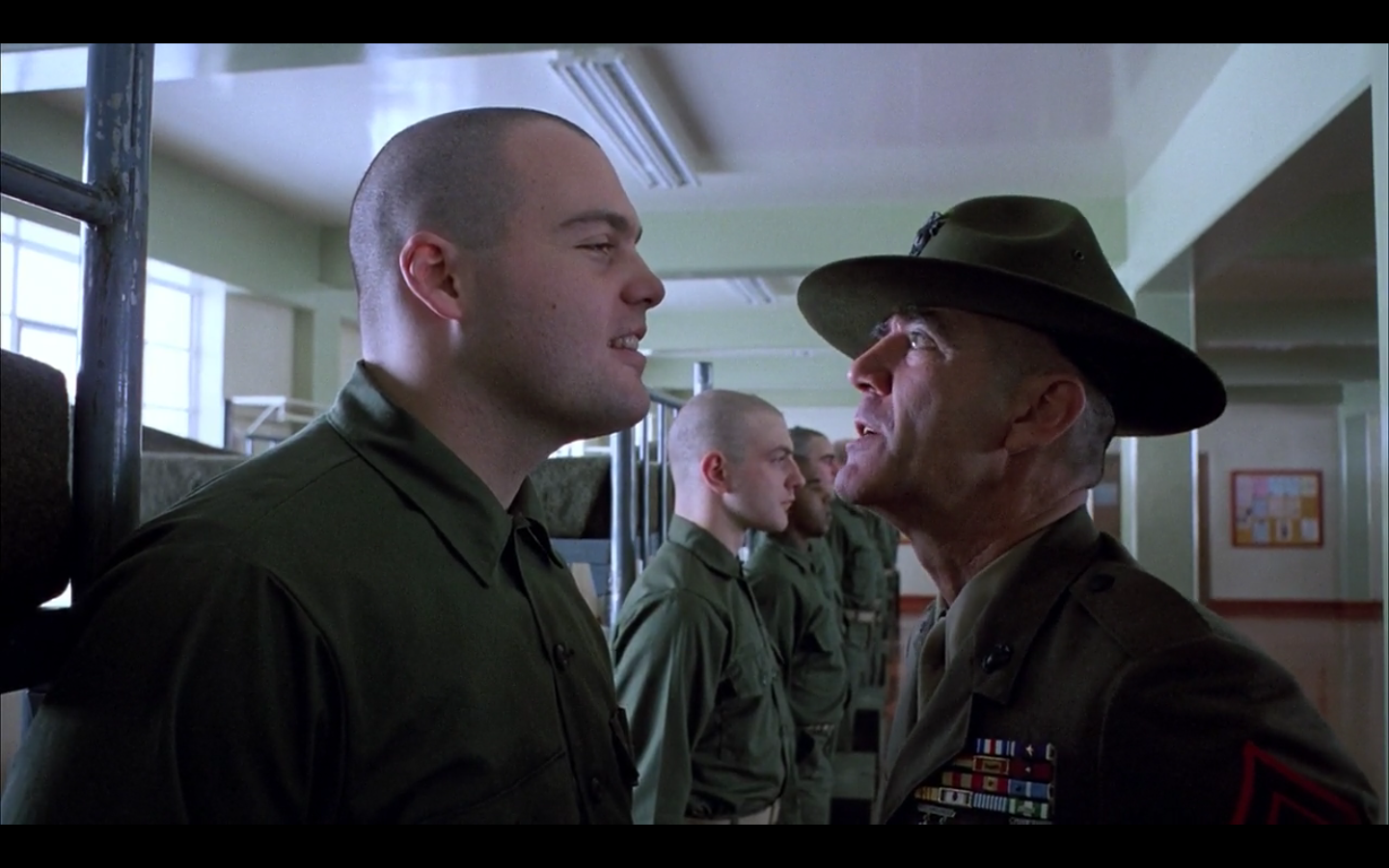
Following the man as he walks along the line of privates. Somewhat low angle with a medium shot.
 Close-up on the two characters at an eye level angle sorta.
 Long shot with a view of everybody, camera follows the man until he reaches the far left. Eye level angle.
 Low angle and a medium close up

 
 Big close-up of the man's face.
Big close-up and a somewhat over shoulder shot
Another big closeup with an over shoulder view. Eye level angle


Wednesday, November 23, 2011

Ma Veray Furst Memoray

The text being analyzed is the poem First Memory by Louise Glück, a poem possibly about some of the memories the author had as a child.

The first big idea would have to be revenge, that's what drives the thought in this poem. The word wounded could be in service of this idea of revenge. He's been 'wounded' and wants revenge for the wrong-doing. At the end of this idea there is repetition of a certain phrase: 'For what he was - for what I was:'. Although the 'he' and the 'I' are in juxtaposition to each other. The colon forms the transition to the next big idea.

The two most important words of this second big idea are most likely pain and loved. The pain was connected to the fact that he wasn't loved, or rather that's what he thought the pain was. The word loved is repeated, although with contrasting context 'I was not loved. It meant I loved.' The author starts the first idea and second idea the same by saying 'Long ago' and 'From the beginning of time'. Both of these statements are a reference to his past.

This poem portrays a memory and strong emotion through the author's use of repetition and punctuation.

Monday, October 17, 2011

Mr V

ACT I

PROLOGUE

Enter Chorus
Chorus
O for a Muse of fire, that would ascend
The brightest heaven of invention,
A kingdom for a stage, princes to act
And monarchs to behold the swelling scene!
Then should the warlike Harry, like himself, (5)
Assume the port of Mars; and at his heels,
Leash'd in like hounds, should famine, sword and fire
Crouch for employment. But pardon, and gentles all,
The flat unraised spirits that have dared
On this unworthy scaffold to bring forth (10)
So great an object: can this cockpit hold
The vasty fields of France? or may we cram
Within this wooden O the very casques
That did affright the air at Agincourt? +End of idea
O, pardon! {since a crooked figure may (15)
Attest in little place a million;} -1 thing stands for many
And let us, ciphers to this great accompt,
On your imaginary forces work.
Suppose within the girdle of these walls
Are now confined two mighty monarchies, (20
Whose high upreared and abutting fronts
The perilous narrow ocean parts asunder:
Piece out our imperfections with your thoughts;
Into a thousand parts divide on man,
And make imaginary puissance; (25)
Think when we talk of horses, that you see them
Printing their proud hoofs i' the receiving earth;
For 'tis your thoughts that now must deck our kings,
Carry them here and there; jumping o'er times,
Turning the accomplishment of many years (30)
Into an hour-glass@!: for the which supply,
Admit me Chorus to this history;
Who prologue-like your humble patience pray,
Gently to hear, kindly to judge, our play.
Exit
The Big Idea: We're Not Worthy
-In the chorus the speaker says we will have to use our imaginations to make the story come to life.
Ideas in service:
-'I wish' lines 1-4
O for a Muse of fire, that would ascend
The brightest heaven of invention,
A kingdom for a stage, princes to act
And monarchs to behold the swelling scene

-Henry V = War lines 5-8
'fire sword famine (listing) = death

Not the people nor the space to do justice lines 8-14

Line 15-32


English Renaissance
-Aristocracy
-Nobility
-Notaries and scribes
-Merchant class
-Yoeman

In the English Renaissance, the Renaissance that filtered down the furthest of any of the other countries in Europe,

Thursday, October 13, 2011

Saaaaaaaaaaaaaaaab Baby

The aspect of this advertisement that attracts the viewers attention is the image itself. The Saab 9-7X SUV takes up the majority of the advertisements space, you can't avoid not looking at it. In addition to that the vehicle is shiny, clean, and looks nice. It looks powerful too. The first sentence in the statement is bold and large, grabbing your attention even more. 'An SUV with altitude', through subtlety the message makes the viewer think that this vehicle is superior to others, the higher you are the better. What develops desire is the words used in the bottom paragraph. They give the audience a small insight on the history of how Saab was founded by 16 aircraft engineers. Some people viewing this ad may think that they themselves would think it's awesome to have a vehicle influenced by aircrafts. The very last two sentences of this advertisement brings the audience/viewer into the ad itself by addressing the audience. 'After all, once you've built jets, you don't build just another SUV. Enjoy your flight.' By addressing them you then make the audience think it's all about them, which it might be.

Within this advertisement is a few propaganda tools and rhetorical devices. There's a great amount of repetition within the advertisement that's used. The company constantly refers to the fact that it's an SUV and that the car was built by Saab. There's also the repeated reference to aspects of flight where the ad mentions 'altitude', 'aircraft engineers', 'jets', and 'flight'. There's the Saab company logo clearly printed in the top along with their slogan 'Born From Jets' as well. They make use of jargon slightly by using fancy terms like '300-hp Displacement on Demand V8 engine' and using sentences that make it seem all the better like 'optimizes fuel efficiency without sacrificing performance'.

The big idea of this advertisement is the influence that flying and altitude has on the company Saab and their 9-7X SUVs. In service of the big idea; their most powerful sentence in large and bold letters 'An SUV with altitude'. The company really tries to emphasize the way the SUV embraces the company's history and the fact that they're car designs are superior by having more altitude. They state that 'Saab was founded by 16 aircraft engineers and their spirit lives on'. They're still embracing their history and using it in their cars. They've built a powerful new SUV

The targeted audience for this advertisement would be the North American market and it's buyers and sellers. The bottom left of the advertisement shows a tiny Saab Automobile USA sign and the price given is in dollars as well.

Monday, October 10, 2011

Paper Reflection

The big idea of my paper was to express how graffiti is cool. I constantly tried to refer to statement that graffiti is cool and how the aspects of it that I introduced in the paper were also really cool. By doing so I was sticking to the main and central message of my paper. I had the basic layout of a proper essay; my introduction, body paragraphs, and then lastly my conclusion. I had hooks for my introduction and my conclusion but only one or two of my body paragraphs had hooks. My body paragraphs also didn't follow much of the needed format of what body paragraphs need: hook, introduction, thesis statement, etc. Overall, I believe my essay on how and why graffiti is cool was a success. I personally liked the various topics I chose to discuss and the different forms of media I used. I believe my grammar and spelling were almost top-notch too.

Tuesday, October 4, 2011

Porto and Sherry Sandeman, 1931


Adverts

AIDA - Attracted attention by the repeated amount of Coca Colas. It says 'Continuous Quality Is Quality You Trust', this would go with develop interest. It says Coca-Cola and then it says Coke (Develop desire). The bottom left says 'Ask for it either way... Both trade-marks mean the same thing.' (Move to Action)  

Sunday, October 2, 2011

GRAFFITI

Graffiti

My mama always said graffiti was like a box a chocolates, never know what you’re gonna get. Over the years, some people have viewed graffiti as a cool art form that adds life to the drab greys of a city. One of the coolest aspects of graffiti as an art form is the fact that every single piece is unique. There’s always a piece of graffiti out there that is newer and different to the last one. It’s an art form that is constantly changing. There are various well-known artists who are praised by many for their works such as Banksy and Seen. They are seen as some of the coolest and most influential graffiti artists. There have even been artists who use various other methods to create street art; one using tiles and some using knitting. Graffiti is a vast and powerful art form. Although graffiti had to start from somewhere.

Urban graffiti all started back in New York in the late 1960s with a man who called himself Taki 183. This was his tagging name that he would quickly write around the city, in a way making himself known. Tagging is the term used for a graffiti artist’s unique signature. Tags are to be done quickly with marker or spray paint and are basically saying ‘I’m here’ or ‘I was here’. Taki 183 had first begun using a marker of the sorts to put up his tag wherever he was; he even started the trend of putting up your own tag on and in subway trains. Through doing this Taki 183 became extremely well known throughout the city, although nobody knew he was. The youths of New York at the time had realized how infamous and notorious they could become by putting their own tags on subway trains and all over the city. The idea caught on like wildfire. Their goal was to go become as well known as possible and be in as many places as possible. In this image there’s still a remnant of Taki 183’s tags from the 60s. Over time you can even see that other people have put up their own tags or their own memos. It’s a cool way for these people to leave something of themselves behind. Something so tiny and simple yet so significant spread one of the coolest forms of art known today.

Permanent markers were used in the beginning but as tagging grew, people turned to using spray paint. Spray paint enabled the tag to grow in size and expand in color. It wasn’t enough for people to have their tag scrawled all over the place because now everyone was doing it. Spray paint creatively separated taggers from artists with color, size, style, and form. With this the tag became so much more and became something more artistic than the original tag. This new style was (and still is) called throw-up, where there are two primary colors in the tag made with an outline or made with bubble-liking and large letters. From this style it evolved into other more complicated and wild styles. For some artists it’s the only way get themselves out there.  

Graffiti is something people have taken and evolved into colorful works of art that represent identity. Classic artists can have the higher class and such gaze upon their works in a gallery or museum but graffiti artists want their ideas and works out in the open, ready for the common and lowly to see, for the delinquents and younger generation to admire, and ready for the oldies to judge right or wrong. Graffiti artists are literally pouring their creativity out into the open on a wall or forcing a message upon the people. Cath Crowley, the author of Graffiti Moon, wrote a passage about graffiti saying, “I spray the sky fast. Eyes ahead and behind. Looking for cops. Looking for anyone I don't want to be here. Paint sails and the things that kick in my head scream from can to brick. See this, see this. See me emptied onto a wall.” It’s an interesting quote that explains the thrills of graffiti. The thrill of spray painting on a wall in the dead of night hoping you don’t get caught and the thrill of how it will turn out and what people’s opinions of it will be. The passage is explained in a cool narrative way. Graffiti is cool for this reason; it’s a thrill and it’s exhilarating.  

Graffiti hasn’t always been praised and thought of as cool, many people see it as vandalism and see it as an eyesore. Although a lot of these people are the people who hold jurisdiction of the city, such as the mayor, his office, and the police force. Graffiti spreads quickly once it’s started in an area, relative to a Domino Effect, so the police try and prevent this. The mayor is the person responsible for the image and status of the city so they see graffiti as something that mars the face of their city. People of an older generation also tend to see graffiti as an eyesore to the local neighborhood area. Although there are a few exceptions like the older generation, there are graffiti artists from the older generation as well. In truth there is graffiti that can be widely agreed upon that it is vandalism. Graffiti can be defined and pictured as just somebody spraying random words and other jargon on a wall. This kind of graffiti isn’t the kind that is cool though. The graffiti that counts as cool and that matters to people who enjoy art are the works with color, effort and time, and talent. Some artists though have taken to other styles of graffiti.

Banksy is one of the most significant artists in the graffiti scene and also one of the most influential. His graffiti works are strongly based on using stencils. With his stencils he can make a detailed work that is different than the regular graffiti that is thrown up as a name or tag in color. Banksy’s works tend to have strong political messages within them. His works tend to be humorous and satirical, often a subtle commentary on politics and society. His works are seen all over the world but the majority are in England, his home country. Banksy is definitely the coolest graffiti artist of his generation at the moment. His stenciling technique is brilliant and the images he paints are what people really like. Some people enjoy seeing graffiti pieces decorating a wall. Banksy usually spray paints with black and white, rarely using color. Another cool thing about Banksy is that his works are crude and absurd, making people think along the lines of ‘How dare he’ or ‘How could somebody just put that up’. In these examples of Banksy’s works there is a man of the Queen’s Guard taking a leak. These men are usually seen as serious and committed and this just defaces their uptight demeanor, they’re capable of being misfits like the rest of society. People see this as funny and cool, his other works to portray such childishness and brilliance as well. His work Naked Man is a depiction of the classic and comical scene of a father trying to catch the young man with his daughter. All in all Banksy has an amazing and cool stenciling technique that many are trying to imitate themselves these days. 

Don Seen UA, the Godfather of Graffiti. Seen has been stated as the Godfather of graffiti but he was not the first man to start up the movement. He’s well known globally and he has his crew United Artists (UA) that is made up of other artists like his brother Mad, Pjay, Sin, and Duster. In the 70’s Seen and his crew started with spray painting New York’s subway lines, quickly gaining them reputation as a crew and individuals while the lines moved all over the city. Not only his talent but these subway lines that carried Seen’s works and were completely covered in them are what made him one of the coolest graffiti artists out there and still is. The state of his fame was and still is vast, at one point outside of NY he even tagged the Hollywood sign in LA. He’s even had some of his art and graffiti in galleries alongside works by Andy Warhol, Keith Haring, and Basquiat. Other graffiti artists have gained fame with different use of materials though.  

Grandmothers and their knitting have suddenly become cool. Graffiti has even expanded into various other forms of street art. Graffiti artists such as Invader and women who love knitting have even used other ways and forms to make street art. Invader grew up with a love for the game Space Invaders and many other 8-bit games, from that he derived what his artworks would be and what his name would be. His works all tend to focus on 8-bit video game characters from the 80s, such as Pacman and Space Invaders.  The medium he uses for his works is small, colorful, and squared tiles that make up the image of the invaders or the ghosts from Pacman. The tiles have a very strong paste on the back that allows them to be stuck anywhere throughout a city. It’s a different way to make street art and that’s what’s cool about it, it’s innovative. Women and sometimes men all over the globe have started a genius and cool new form of street art. They cover statues, street poles and lamps, rails, and various cold and metal objects with hand-knitted sweaters, socks, full on coverings. This image of the Charging Bull near Wall Street, NYC shows that it’s been completely covered in a pink and purple knitted sock by the artist Olek. There’s even been a case where Olek has crocheted an entire Mustang convertible.  

Even if I knew that tomorrow the world would go to pieces, I would still tag that wall. Graffiti has been seen as vandalism or as art since it’s start in the 60s but whether it is either, it will always be cool. Graffiti evolved from simple scribbles of ones own identity all over an area and then evolved into something more creative and suddenly it became a loved and hated art form. There are artists who have become big enough to influence people with their works and messages and all with the use of cans of paint. Who knows? Maybe todays top graffiti artists will be seen hundreds of years from now the way we currently see Da Vinci or Van Gogh.